The KYC and AML processes that once defined competitive advantage are becoming the baseline. The firms pulling ahead are those embedding AI into the heart of their CLM journeys, and the gap is widening.
By Mike Pszenicki who works with banks and financial institutions across the UK and Ireland to redesign their CLM operating models and deliver more efficient, compliant, and client-centric onboarding experiences.
At Delta Capita we are seeing multiple firms either exploring AI builds internally or speaking to vendors. Pressure from leadership is relentless to “keep up” but there is a wide gap between those paying lip service to the concepts and those realising value now.
The primary AI risk in CLM today is not model performance or compliance sign-off; it's false confidence in readiness. A CLM AI Healthcheck surfaces where that confidence is misplaced.
For anyone leading CLM Operations or Financial Crime Compliance at a financial institution today, the pressure is familiar: rising regulatory expectations, growing client volumes, mounting costs, and a persistent demand from the business to onboard faster and retain clients more efficiently. The combination is unforgiving. Manual, fragmented processes that were "good enough" five years ago are now a strategic liability.
The good news? We are at an inflection point, one where AI enhancements to Client Lifecycle Management are no longer experimental. They are delivering measurable, scalable value across onboarding, KYC refresh, and ongoing monitoring. The question is no longer whether to adopt AI-driven CLM; it is how quickly you can deploy it before your competitors do. If you are still only “piloting AI”, you may be eroding your business case.
The Cost of Standing Still
Let's be direct about what the status quo actually costs. For a mid-to-large financial institution, the operational cost of running KYC onboarding and periodic review programmes typically runs into tens of millions annually, sometimes far more. A significant proportion of that cost is absorbed by low-value, repetitive work: document collection chasing, data re-keying, adverse media trawling, risk scoring recalculations that analysts run manually, and escalation queues that bottleneck relationship managers.
Beyond direct cost, there is the revenue impact. Time-to-onboard remains one of the most cited reasons clients abandon or deprioritise a banking relationship at inception. Industry benchmarks consistently show that onboarding journeys stretching well beyond two to three weeks, common for complex corporate or institutional clients carry meaningful drop-off risk. Delay is not just an operational inconvenience. It is a commercial problem with a calculable price tag.
Regulatory risk compounds this further. Periodic KYC review backlogs are not abstract compliance concerns — they translate directly into regulatory findings, remediation programmes, and, increasingly, enforcement action. The cost of a poorly managed CLM process extends well beyond the operations function.
What AI Actually Changes in CLM
The application of AI across the CLM lifecycle is now mature enough to move from proof-of-concept into production at scale. The value levers are well established, and, based on what we are seeing deployed at leading institutions, the outcomes are compelling.
Intelligent document processing and data extraction removes the manual burden of reviewing, classifying, and extracting data from corporate documents, Ultimate Beneficial Owners (UBOs), and identity materials. Modern AI models achieve accuracy levels that exceed manual review while processing in seconds rather than hours.
Dynamic risk scoring allows AI to continuously recalibrate client risk profiles based on real-time signals: changes in ownership structures, adverse media hits, sanctions developments, or transactional behaviour. Static, point-in-time risk assessments, the norm in most legacy CLM models, are replaced by living profiles that trigger review only when genuinely warranted, reducing unnecessary refresh cycles and focusing analyst effort where it matters most.
AI-assisted due diligence and case management accelerates the analyst workflow significantly. Rather than an analyst opening ten browser tabs to triangulate a client's ownership structure or screen for adverse media, AI surfaces pre-synthesised intelligence, flags material risks, and generates first-draft narratives for review. The analyst becomes a decision-maker, not a data gatherer.
Agentic orchestration and workflow automation replaces fragmented manual handoffs with a continuous, intelligent data stream — routing cases, managing SLA escalations, and prompting next-best actions without human intervention at every step. When deployed well, the results are transformative.
Taken together, these capabilities do not merely reduce cost — they compress time-to-revenue, improve client experience, and strengthen the quality and defensibility of compliance outcomes simultaneously.
Where these outcomes are absent, it is rarely due to model performance – it is likely due to readiness gaps upstream.
Why Now Is the Right Moment
Three forces have converged to make this the right moment for financial institutions to move decisively on AI-enhanced CLM.
First, the technology is ready. Large language models and purpose-built AI solutions for financial services CLM have matured dramatically. The risks associated with early-stage AI deployment, hallucination, interpretability gaps, regulatory acceptance, are being actively managed through model governance frameworks, human-in-the-loop design, and increasing regulatory engagement with AI in compliance contexts.
Second, the regulatory direction of travel is becoming clearer. Regulators across the FCA, EBA, and beyond are signalling some doors open to risk-based, technology-enabled compliance approaches. AI that enhances auditability, consistency, and coverage is increasingly viewed more favourably than manual processes prone to human error and inconsistency. Firms that have engaged proactively with regulators through innovation hubs and sandbox programmes are already operating with greater confidence and speed.
Having said that, the EU is the most explicit regime, with a tight leash as mentioned. The US, on the other hand, is drifting in regulation without enough AI-specific guidance. In APAC the view is varied: Singapore, as an example, is getting disciplined, but Australia is racing to catch up. For the many very globalised financial institutions where the CLM journeys are necessarily cross jurisdictional, these challenges must be considered carefully.
Third, competitive differentiation is still available, but narrowing. Institutions that deploy AI-enhanced CLM now will build the data assets, operational muscle, and client experience advantages that compound over time. Those that wait will find themselves in catch-up mode, deploying at greater cost against a higher baseline.
Not sure where your CLM environment actually sits on that curve? Book a 20 minute AI Healthcheck call and get a structured, no-obligation conversation with our CLM team to pressure-test your readiness across data, technology, governance, and change.
Before You Build: Know Where You Stand
In more than half the AI-enabled CLM programmes we see, the AI works, but the organisation cannot operationalise it.
One of the most common and costly mistakes we see is institutions attempting to layer AI onto a CLM environment that is structurally unprepared to support it. AI cannot be built on top of fragmented data, locked legacy workflows, or invisible manual workarounds. The result is typically a proof-of-concept that never scales, and a business case that never lands.
This is why the starting point is not a technology decision. It is a diagnostic one.
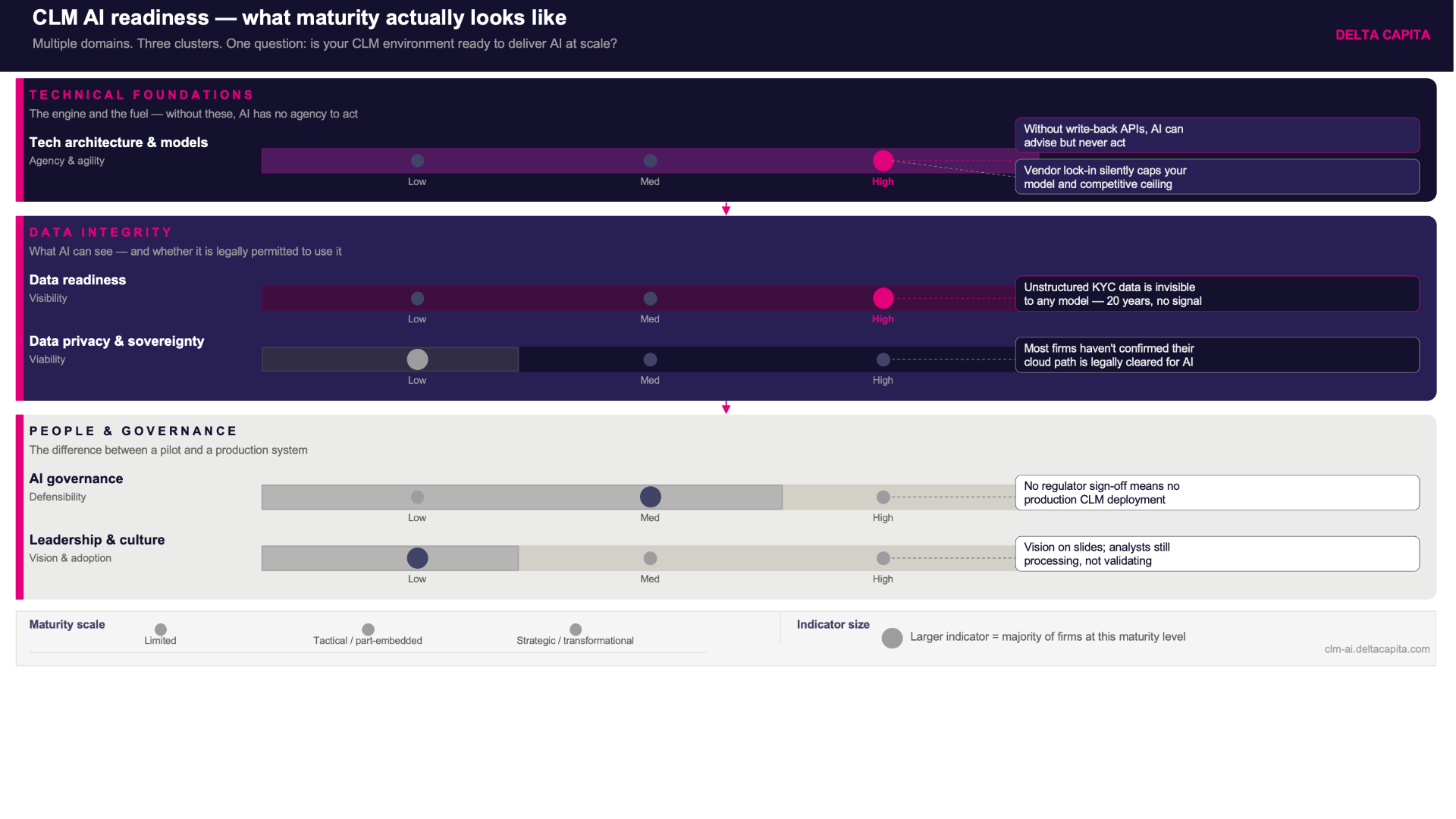
At Delta Capita, we have developed a structured CLM AI Healthcheck specifically designed for CLM environments. It evaluates your organisation across several domains that determine whether, and how quickly, AI will actually deliver ROI in your context. As you consider these factors, answer them with honesty. False confidence will not better your outcomes.
Example of CLM AI Healthcheck review domains:
How would your CLM environment score across these domains? Most teams are confident in two or three areas, and quietly exposed in the rest. A 20 minute AI Healthcheck call with our CLM team will give you an honest, structured read across all of them.
Data quality and architecture: Ownership structure buried in an image within (many) PDFs. How do you expect quick reasoning with that data without significant processing power? Is your client data structured, centralised, and machine-readable, or buried in narrative notes and fragmented legacy systems?
Technology and API accessibility: Can your KYC workflows be triggered programmatically, or are they locked inside:
Legacy UIs that require human “next” click interaction at every step?
A static if-then-else workflow pattern?
Vendor and model strategy: Are your agreements and CLM vendor contracts structured to support a modular, AI-first architecture, or do they create lock-in that constrains your options?
AI governance and model risk management: Can you immediately distil and explain why a risk score has changed which is audit-ready? Is there a clear ownership model for AI decisions, a human-in-the-loop framework proportionate to risk? Have you proactively engaged your regulator on AI in AML and KYC, or are you operating under assumptions that may not withstand scrutiny?
Leadership, culture and change readiness: Does your organisation have the operational history and change capability to sustain a non-linear transformation, or are there hidden blockers that will stall deployment?
Critically, the assessment produces a clear maturity score across each domain and identifies the specific structural changes needed before AI can be deployed at scale. It is an outside-in diagnostic that benchmarks your model against industry peers and the most effective AI-ready CLM frameworks we have seen across global financial services.
This is not a theoretical exercise. It is a practical foundation for building a credible, costed roadmap.
And one that sequences investments to deliver early wins while laying the groundwork for broader transformation across the full CLM lifecycle.
Want this assessment run against your environment? Book a 20 minute AI Healthcheck and we'll walk you through how the diagnostic works and what an honest score would surface for your organisation.
Making the Business Case Land, Not Quietly Stall
One of the most persistent challenges we encounter is not a technology problem; it is a framing problem. AI in CLM tends to get positioned as a compliance technology investment. The more powerful framing is as a commercial enabler: faster onboarding, lower cost-to-serve, reduced revenue leakage from attrition, and a compliance function that scales without proportional headcount growth.
Heads of CLM Operations and Financial Crime Compliance are uniquely positioned to own that narrative. The data exists within your own operations to build the business case: onboarding cycle times, refresh backlogs, analyst capacity, drop-off rates, cost per case. The ROI from well-deployed AI CLM solutions is not theoretical. It is quantifiable, and in most institutions, it is compelling.
Do you report to management that “we are underway with two AI pilots in our business”? This is fluffy and inconclusive. Will they scale? Is the foundation in place? What blocks us from capitalising now?
The firms seeing the greatest returns from AI in CLM share a common trait: they moved beyond pilot programmes and into production deployment with a clear operating model that integrates AI into analyst workflows, not alongside them. They also knew, before they started building, exactly where their environment was ready and where it was not.
How Delta Capita Can Help
If AI-enhanced CLM is on your agenda in the next two quarters, the most useful next step is not a vendor demo or a tooling shortlist. It’s 20 minutes with our CLM team to map where your environment is ready, where it isn't, and what would move first.
One Client, Many Hierarchies: The Data Problem Hiding Inside Every CLM Programme
Most CLM data problems aren't about volume. They're about competing client hierarchies that never reconcile. Here's what they are and why they matter.
Blog
Sep 4, 2026
The CLM Experts™: Why Delivery Centres Matter in Modern Client Lifecycle Management
Discover how Delta Capita's CLM Delivery Centres in Dublin, Wrexham, and Bangalore deliver expertise, scale, and innovation across client lifecycle management.
Company News
Aug 25, 2026
Delta Capita Named a Major Player in the IDC MarketScape for Corporate Client Life-Cycle Management for Financial Services 2026
Delta Capita, a provider of Advisory, Technology, and Managed Services for Client Life-Cycle Management (CLM) and Know Your Customer (KYC), today announced it has been named a Major Player in the IDC MarketScape: Worldwide Corporate Client Life-Cycle Management for Financial Services 2026 Vendor Assessment, doc #US54117826, August 2026.
Your experience on this site will be improved by allowing cookies.