Vincent O’Rourke, CLM European (UK&I) Head of Sales, examines how the CLM market has fundamentally changed, and why traditional commercial models are no longer fit for purpose. As volumes rise and regulatory scrutiny intensifies, he explores what banks must rethink to align pricing with today’s CLM operating reality.
Client Lifecycle Management (CLM) has undergone one of the most significant, and underestimated, transformations in financial services and regulated industries over the past decade. Banks are managing materially higher client lifecycle volumes driven by onboarding, remediation, periodic reviews, and regulatory change. McKinsey reports that onboarding a corporate banking client can take up to 100 days, highlighting how rising onboarding, remediation, and review volumes are stretching legacy client lifecycle operating models.
At the same time, regulatory scrutiny of client due diligence, transparency, and auditability has intensified, placing CLM firmly in the supervisory spotlight. Operating models have also become more complex and globalised, with CLM spanning multiple jurisdictions, booking centres, and delivery models. Yet despite this shift, many CLM commercial models in banks continue to be structured around static capacity and predictable demand assumptions.
That mismatch is no longer a minor inefficiency; it’s a structural problem. Traditional CLM pricing structures were built for a world where work was linear, demand was predictable, and delivery volumes were relatively stable. Our internal research indicates corporate onboarding can cost up to $20,000 per client.
Today, client needs fluctuate, regulatory priorities shift quickly, and operational resilience matters as much as cost control. The result is simple: commercial models that don’t reflect how CLM work happens create friction, cost surprises, and misaligned incentives. In regulated environments, this misalignment doesn’t just create inefficiency, it increases operational risk and regulatory exposure over time.
So, the question organisations are now forced to ask is more fundamental than “How much does this cost?”: Are our CLM commercials truly aligned to how we operate today? Increasingly, the answer is no.
The New Baseline: Delivery Isn’t the Differentiator
Modern CLM clients are no longer focused solely on “getting the work done”. Delivery is the baseline expectation, not a differentiator.
What clients want now is clarity over what they are paying for, flexibility in how services scale, and transparency in how value is created and measured.
Cost predictability still matters, but so does accountability. Agility matters, but not at the expense of governance. Above all, clients want commercial structures that reflect real consumption and real outcomes, not abstract effort. That shift in expectation requires a rethink of how CLM services are priced, consumed, and managed.
Quick Self‑Check: Are Your CLM Commercials Already Out of Date?
If any of the following feel familiar, your commercial model may be working against you:
Demand rises and falls, but your commercials assume steady volumes.
Priorities shift quickly, but pricing assumes linear, predictable delivery.
You want transparency and governance, but struggle to see how value is measured.
You’re managing CLM like an operating function but paying for it like a project.
This is where many CLM programmes lose momentum: not because the work can’t be done, but because the commercial model isn’t designed for modern operating reality.
A More Flexible Approach to CLM Commercial Models
At Delta Capita, we’ve spent significant time listening to clients across different geographies, regulatory environments, and levels of CLM maturity. What’s become clear is that no single commercial model works for every organisation, or even for the same organisation at different points in time.
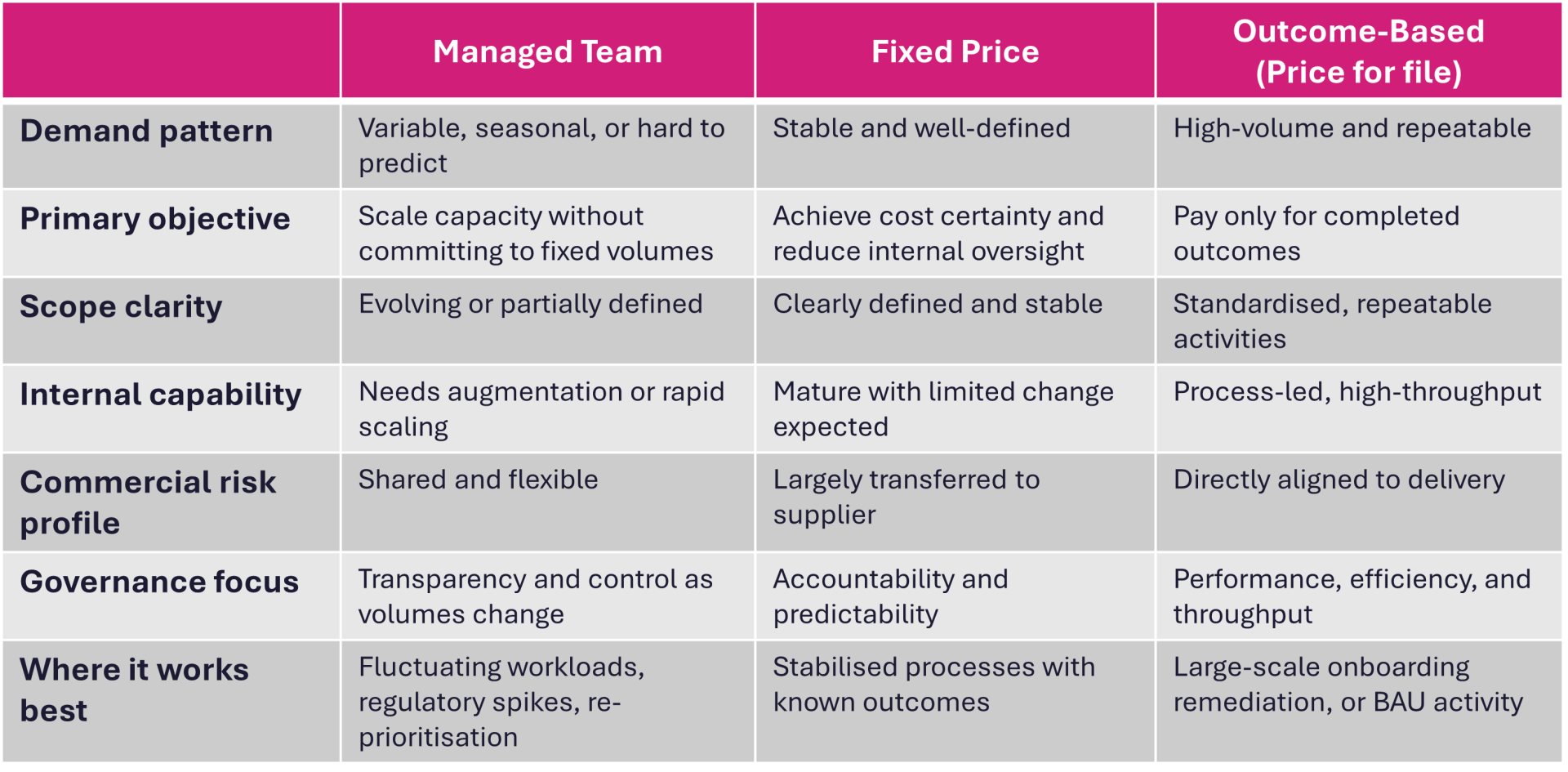
That insight has shaped a flexible approach built around three core commercial models, but framed around the outcomes clients actually need, not a one-size-fits-all pricing template.
Choose the Model That Matches Your Operating Reality
1. Managed Team: When you need to scale capacity without committing to fixed volumes
Managed Team models provide flexible access to specialist CLM expertise and scalable capacity. They are particularly effective where demand fluctuates, where in-house capability needs to be supplemented quickly, or where clients want transparency without committing to fixed volumes. Pricing scales with demand, enabling responsiveness without sacrificing control.
Best fit when: your workload is variable, your internal bandwidth is constrained, or your operating model needs flexible coverage without locking into rigid volume assumptions.
2. Fixed Price: When you need cost certainty and clear accountability
Fixed Price models address a different challenge: predictability. Where scope is clearly defined and outcomes are well understood, fixed pricing delivers cost certainty alongside supplier-owned accountability for delivery. This resonates strongly with organisations looking to stabilise costs and reduce internal management overheads.
Best fit when: scope is stable, the process is well-bounded, and the primary goal is to reduce internal oversight and variance.
3. Outcome Based (Price per File): When you want true consumption-based pricing tied directly to delivery
Outcome Based (Price per File) models go further by aligning pricing directly to delivery. Clients pay only for what is completed, creating true consumption-based pricing. This shifts the focus away from effort and towards outcomes, making it particularly compelling for high-volume, repeatable CLM activities.
Best fit when: volumes are high, activities are repeatable, and you want commercial alignment that rewards delivery and efficiency, not time spent.
The Real Advantage: Commercials That Can Evolve as Your Needs Change
Each model can stand alone, but their real strength lies in the ability to combine or evolve them as client needs change.
That matters because CLM rarely stays still. Maturity increases, regulatory priorities shift, internal capabilities develop, and volume patterns change. A commercial structure that works today can become a constraint tomorrow, unless it’s built to adapt.
What “Good” Looks Like in Modern CLM Commercials
What unites these models is a shared philosophy: transparency, flexibility, and alignment to value. In an environment where cost efficiency is under constant scrutiny, clients need confidence that their CLM partner’s incentives are aligned with their operational priorities.
The days of one-size-fits-all CLM commercials are over. Organisations want models that reflect how work is delivered, how risk is managed, and how success is measured.
How Delta Capita Can Help
If you’re re-examining how your CLM operations are priced, governed, or scaled, the right conversation isn’t just about cost. It’s about fit, flexibility, and long-term value, and ensuring your commercial model supports the way your CLM function actually operates today.
One Client, Many Hierarchies: The Data Problem Hiding Inside Every CLM Programme
Most CLM data problems aren't about volume. They're about competing client hierarchies that never reconcile. Here's what they are and why they matter.
Blog
Sep 4, 2026
The CLM Experts™: Why Delivery Centres Matter in Modern Client Lifecycle Management
Discover how Delta Capita's CLM Delivery Centres in Dublin, Wrexham, and Bangalore deliver expertise, scale, and innovation across client lifecycle management.
Company News
Aug 25, 2026
Delta Capita Named a Major Player in the IDC MarketScape for Corporate Client Life-Cycle Management for Financial Services 2026
Delta Capita, a provider of Advisory, Technology, and Managed Services for Client Life-Cycle Management (CLM) and Know Your Customer (KYC), today announced it has been named a Major Player in the IDC MarketScape: Worldwide Corporate Client Life-Cycle Management for Financial Services 2026 Vendor Assessment, doc #US54117826, August 2026.
Your experience on this site will be improved by allowing cookies.