
As financial institutions increase investment in AI, many Client Lifecycle Management (CLM) programmes stall by moving too quickly from automation to GenAI. This blog examines AI maturity in onboarding, explaining why the absence of context, memory, and orchestration limits impact, and why onboarding must evolve into a more intelligence‑led operating model.
The Capital Markets sector, particularly across Wholesale coverage, is undergoing a profound transformation as firms seek to use artificial intelligence to streamline onboarding and CLM. The vision is compelling: intelligent agents that automate workflows, accelerate compliance, and improve client experience. Yet turning this vision into real‑world impact remains complex and challenging.
This blog marks Part 1 of a two‑part series exploring AI maturity in onboarding and Client Lifecycle Management (CLM). Drawing on his global experience, Sean Vickers, Chief Commercial Officer – CLM, shares his perspective on how AI is reshaping onboarding and CLM across Capital Markets, focusing on why many programmes stall when they move too quickly from automation to GenAI. It sets the foundation for Part 2, which examines how this maturity gap is being addressed through agentic CLM and a Managed Services as Software (MSaS) model.
Understanding the Evolution: From Automation to Agentic AI
The journey from traditional automation to Agentic AI is marked by increasing levels of autonomy, adaptability, and contextual awareness. Early machine learning models offered predictive capabilities but were often brittle and static. Generative AI introduced creativity and language fluency but frequently lacked factual accuracy and domain relevance.
Today, the industry is exploring Agentic AI - systems capable of perceiving their environment, reasoning dynamically, and taking autonomous action. However, it is critical to distinguish true Agentic AI from intelligent automation. Just because a system acts autonomously or makes decisions at scale does not make it agentic. The defining characteristic is adaptation - the ability to learn from feedback and evolve over time.
To clarify this progression, consider the following reimagined framework:
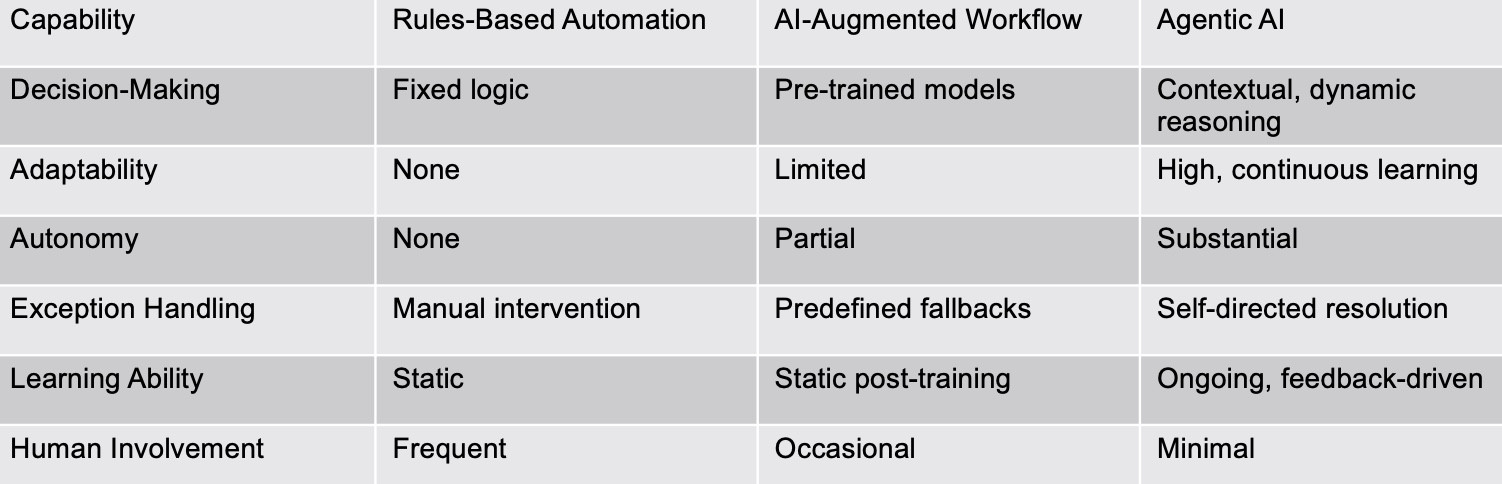
This evolution mirrors the “observe-think-act” paradigm - also known as perception, cognition, and action. Agentic systems must be able to perceive their environment, reason for it, and take appropriate action, all while learning from outcomes.
Stateless Systems and the Risk of Fragmentation
Despite the promise of AI, many onboarding processes remain stateless - treating each transaction as isolated, without memory of prior interactions. This is problematic in Capital Markets, where onboarding involves complex, multi-step workflows with regulatory, compliance, and ownership intricacies.
Stateless AI agents, lacking contextual memory, risk producing fragmented or incomplete outcomes. This not only undermines compliance but also erodes client trust. True agentic systems must retain and apply context across interactions, enabling continuity and coherence in decision-making.
The Reality Check: Incremental Gains, Not Instant Transformation
Initial expectations for AI-driven onboarding improvements, such as 10–20% gains in document processing or false positive reduction, have often proven optimistic. Several structural challenges persist:
- Data Quality: AI cannot compensate for incomplete, inconsistent, or poorly structured data. In fact, it amplifies existing weaknesses
- Governance: Regulatory scrutiny and internal model approval processes are rigorous and time-consuming
- Infrastructure: Secure, scalable environments require significant investment and cross-functional alignment
- Organisational Culture: Resistance to change and lack of stakeholder consensus can stall adoption
These realities underscore a critical point: Agentic AI is not a silver bullet. It is an enabler: one that must be built on strong data foundations, clear processes, and a culture of continuous improvement.
The Role of Feedback Loops and AIOps
One of the most underappreciated capabilities of AI agents is their potential to improve the very data they rely on - if they are embedded within a robust feedback loop. This is why we’re seeing strategic moves like Salesforce’s acquisition of Informatica: combining AI capabilities with enterprise-grade data management.
For the first time, onboarding teams must work alongside AIOps, a new operational layer responsible for monitoring, tuning, and evolving AI systems in production. AIOps ensures that AI agents remain aligned with business goals, regulatory requirements, and real-world performance metrics.
Delivering Tangible Value: Where AI Works Best
Clients are not interested in AI for its own sake. They want faster onboarding, fewer errors, and better compliance outcomes. The most successful firms focus on targeted, high-impact use cases, such as:
- Accelerating document collection and validation
- Enhancing false positive disposition in compliance checks
- Providing explainable AI insights to support human decision-making
These use cases deliver measurable value when supported by clean data, clear rules, and well-defined feedback mechanisms.
Recommendations for Senior Leaders
For firms embarking on the AI journey, we recommend the following strategic principles:
- Challenge misconceptions: Not all automation is agentic. Ensure internal and external stakeholders understand the distinctions
- Build the right foundations: Prioritise data quality, process clarity, and change management before deploying AI
- Define guardrails and personas: Agentic systems require clear rules, auditable personas, and scope for learning - without these, they are just advanced RPA. Sometimes advanced RPA (or even traditional automation) is the answer, but when we want to be smarter, we need the right technical components.
- Embed AIOps early: Treat AI as a living system that requires ongoing monitoring, tuning, and governance
- Partner strategically: Collaborate with experienced providers like Delta Capita to navigate technical, regulatory, and operational complexities
Conclusion: Scaling the Right Decisions
AI is reshaping onboarding in Capital Markets - but only for firms that approach it with clarity, discipline, and strategic intent. Agentic AI is not about replacing humans; it’s about scaling the right decisions, at the right time, in the right context.
The firms that succeed will be those that combine rigorous preparation with targeted application - augmenting human expertise, improving data quality, and embedding AI into the fabric of their operations.
Before deploying AI agents, ask not just what they can do - but how they learn, adapt, and align with your business goals.
How Delta Capita Can Help
With globally available experts and scalable support, we’re ready to guide your AI and CLM transformation. Want to know more? Book a consultation and discover how we can support your AI and CLM journey today.